
End-of-spring brings two pressure points in schools: exam access arrangements and sports day. Both shine a spotlight on motor skills, confidence and participation. If a pupil is finding handwriting slow, PE daunting, or everyday coordination tricky, the Movement ABC-2 (MABC-2) can help you move from “we think there’s a difficulty” to “here is what we will do next.”
This guide explains what the MABC-2 looks like in practice, how long it takes, how results translate into classroom and PE strategies, and when to add tools like Beery Visual Motor Integration (VMI) or the Detailed Assessment of Speed of Handwriting (DASH). You will also find a simple referral-to-provision pathway that aligns with SEN reviews and can contribute evidence where needed.
What the MABC-2 measures and who it is for
The Movement ABC-2 is a standardised assessment of motor coordination used by Occupational Therapists and Physiotherapists to identify strengths and difficulties across three areas:
- Manual dexterity
- Aiming and catching
- Balance (static and dynamic)
It is suitable for children and young people from 3 years to 16 years 11 months. There are age-banded tasks so a Year 1 child and a Year 9 student complete developmentally appropriate activities. Scores are compared with a large, age-matched sample to provide standard scores and percentiles, supported by a traffic light interpretation that helps non-clinicians make sense of results.
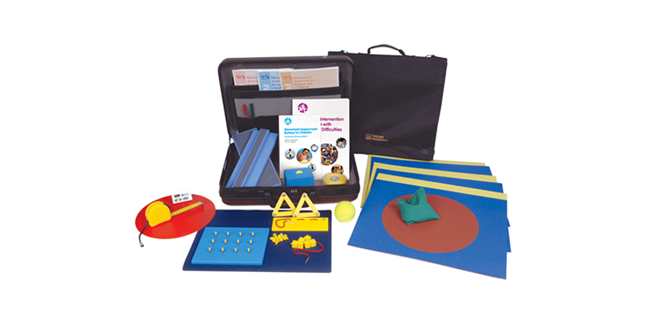
What the subtests look like
Tasks are practical, child-friendly and look like short games. Examples include:
- Manual dexterity: placing pegs quickly, threading beads, turning coins, drawing trails within narrow paths.
- Aiming and catching: underarm beanbag throws to a target, catching a ball with one or two hands at set distances.
- Balance: standing on one leg, walking heel-to-toe along a line, balancing on a board, hopping sequences.
Across all subtests, the assessor also notes posture, effort, movement planning, hand preference and self-monitoring. These observations are vital for translating scores into everyday strategies.
Timing and test conditions
A full MABC-2 typically takes 40 to 60 minutes in a quiet space. Younger children or anxious pupils may need short breaks, which is fine and does not invalidate results when managed within guidance. When we assess in school, we aim for a calm room and a schedule that avoids core lessons or known fatigue points. In clinic, we pace the session to the child and incorporate movement breaks if helpful.
How often can you repeat it? The MABC-2 can be re-administered after several months to a year, depending on the purpose. For monitoring change or providing updated evidence for an SEN review, retesting annually is common. Shorter intervals are used with clinical judgement when there is a clear reason, such as a significant change in presentation.
From suspected DCD to practical help in PE
The MABC-2 is often used when Developmental Coordination Disorder (DCD), sometimes referred to as dyspraxia, is suspected. While diagnosis is made medically, MABC-2 findings offer clear school-facing information about coordination, balance and ball skills that impact:
- PE confidence and safety
- Handwriting speed and legibility
- Dressing for PE and managing kit
- Playground games and social participation
Translating results into PE support might include:
- Simplifying rules and reducing ball speed to build success, then gradually increasing challenge.
- Practising skills in small groups before whole-class games.
- Allowing an agreed role option on tough days (timekeeper, scorer, buddy coach) to protect confidence.
- Using visual demonstrations, floor markers and predictable routines to reduce cognitive load.
- Offering lighter balls, larger targets and consistent start positions for throws.
In class, manual dexterity findings can guide pencil grip trials, sloped boards, checklists for multi-step tasks, and alternative recording during tests when fatigue is the primary barrier.
When to use MABC-2 on its own vs combining with VMI or DASH
Choose MABC-2 alone when the main concern is balance, ball skills or general coordination affecting PE and everyday motor tasks. Add:
- Beery VMI when visual-motor integration or visual perception is in question, for example letter formation that does not improve with motor practice or difficulty copying from the board.
- DASH when exam skills or handwriting output are the priority, especially ahead of May and June assessments. DASH looks at speed and stamina across writing tasks and can support access arrangements where appropriate.
A combined battery (MABC-2 plus VMI and/or DASH) provides a rounded picture: can the child plan and coordinate movement, visually process and reproduce shapes, and produce written work at a functional pace?
For local, practical pathways to handwriting testing, see our overview of handwriting assessments in Cornwall and Devon, including the Detailed Assessment of Speed of Handwriting, which we can deliver where appropriate. You can read more in our page on handwriting assessments.
Quick, reasonable adjustments for exam season and sports day
Small, low-risk changes can protect participation and performance:
- Exams and assessments: stable seating and foot support, a sloped surface, extra time where supported by evidence, rest breaks to manage fatigue, and alternative recording methods for extended writing when permitted.
- PE and sports day: preview the course or events, practice starts and finishes, agree a quiet warm-up and a supportive adult point, offer roles that preserve inclusion if the child opts out of a specific event, and provide clear visual cues for sequencing.
Confidence matters. Build in short, achievable wins before high-profile events and celebrate effort, not only outcome.
A mini case-pathway, from referral to provision
- Referral and information gathering: SENCo and parent flag PE worries and slow handwriting. Pre-assessment forms capture priorities and key dates for exams and sports day.
- Assessment: MABC-2 and/or DASH completed in clinic or in school within the same week where scheduling allows. Observations note postural fatigue, slow in-hand manipulation and cautious ball approach.
- Analysis and report: Scores show below-average manual dexterity and aiming/catching, with borderline balance. DASH indicates slow writing speed with early fatigue. The report maps findings to functional impact, sets measurable targets and lists reasonable adjustments.
- Feedback and planning: We provide feedback to parents, agree next steps and home–school strategies, and, where appropriate, make a referral to the community paediatrician to consider diagnosis of DCD/dyspraxia.
- Provision mapping: Targets and strategies are added to the child’s support plan with a clear review date set for 10 to 12 weeks. We liaise with school as needed to support implementation and monitoring.
If you need a school-focused consultation or to request an assessment, our team works flexibly across Cornwall and Devon. Learn more about arranging a paediatric occupational therapy assessment in Plymouth or our Truro clinic on the Waves OT website. You can also explore options to request an OT assessment if you have upcoming school deadlines.
How results are reported and used
Our reports are concise and ready to share with parents and schools. They include:
- A summary of concerns and context
- Standard scores and percentiles with plain-English interpretation
- Functional implications for class routines, PE and home life
- Measurable targets and practical strategies
- Equipment suggestions and a clear review timeline
We can provide feedback sessions for parents and, where needed, outline how recommendations align with a graduated response in school. If formal diagnostic input is required, we signpost or refer to community paediatrics.
FAQ
- What is the MABC-2 and what age is it for? It is a standardised assessment of motor coordination for ages 3 to 16 years 11 months, covering manual dexterity, aiming and catching, and balance.
- How long does it take and what does it measure? Around 40 to 60 minutes in a quiet space. It measures fine motor control, ball skills and balance, with observations that explain how the child approaches movement.
- How can it help with suspected DCD and PE? Results highlight specific coordination barriers and strengths, guiding targeted PE adaptations, confidence-building and classroom supports. Findings can also support onward medical referral where appropriate.
- How often can you repeat it? Typically annually for monitoring or evidence updates. Shorter intervals can be used with clinical reasoning when there is a clear need.
- How are results reported and used for support plans? We provide clear scores, functional explanations, measurable targets and practical strategies that can be incorporated into Assess-Plan-Do-Review cycles in school.
Next steps
If exams or sports day are on the horizon and you need clear, practical guidance, an MABC-2 can turn uncertainty into a plan. For local families and schools, we offer flexible appointments in Truro and across Cornwall and Devon, with collaborative reporting that supports SEN processes. To discuss a motor skills assessment or combine MABC-2 with VMI or DASH, get in touch through our website.
Helpful links:
- Read about our paediatric OT clinic options in Truro for children’s assessments: paediatric OT clinic in Truro.
- Explore handwriting testing, including DASH, and how it supports exam planning: handwriting assessments with OT in Cornwall and Devon.
- Learn how to request an OT assessment for school support and reviews: request an OT assessment in Truro.
- Find out more about motor skills assessment options in Truro: our page on motor skills assessment MABC-2 in Truro.